Info Detak.co | Minggu, 22 November 2026


Examining Global Geopolitics and Economics through Mafahim Siyasiy and An-Nizham al-Iqtishadi fi al-Islam
By : Slamet Sugianto
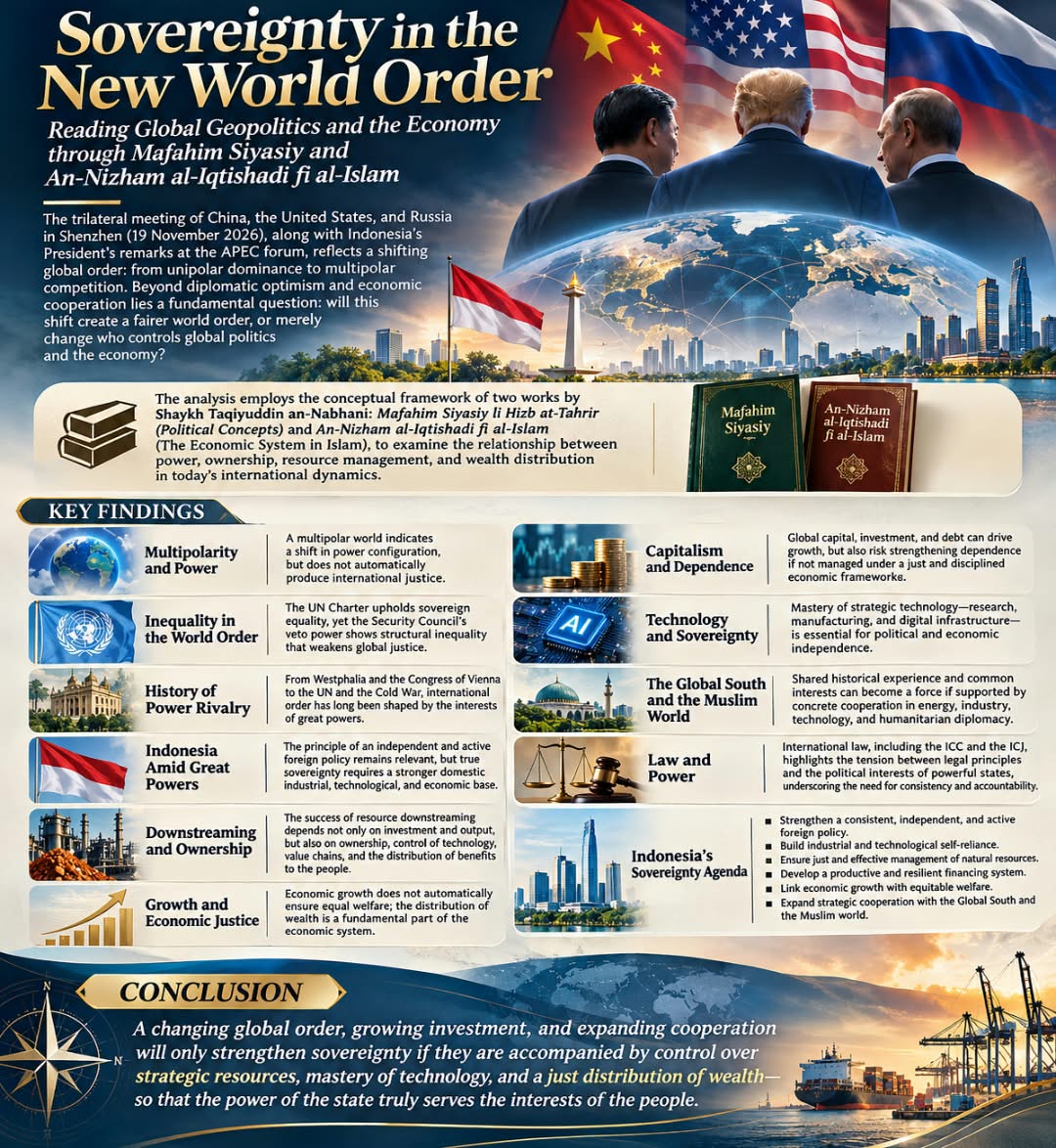
The meeting between Chinese President Xi Jinping, United States President Donald Trump, and Russian President Vladimir Putin in Shenzhen on November 19, 2026, represents an event that deserves to be examined beyond the diplomatic engagement of three major world leaders. Amid shifting international power configurations, trade rivalries, armed conflicts, technological competition, and global economic uncertainty, the meeting offers an important illustration of how major powers seek to shape the direction of the world order.
The resulting declaration addressed several strategic issues, ranging from reform of the United Nations (UN), energy supplies, questions of jurisdiction and immunity for state officials, to the reduction of nuclear risks. However, several international media reports noted that the declaration did not provide concrete details on resolving several major conflicts, including the war in Ukraine and the conflict involving Iran. Therefore, the meeting is more appropriately understood as a significant diplomatic development rather than evidence that the world's geopolitical problems have been resolved.
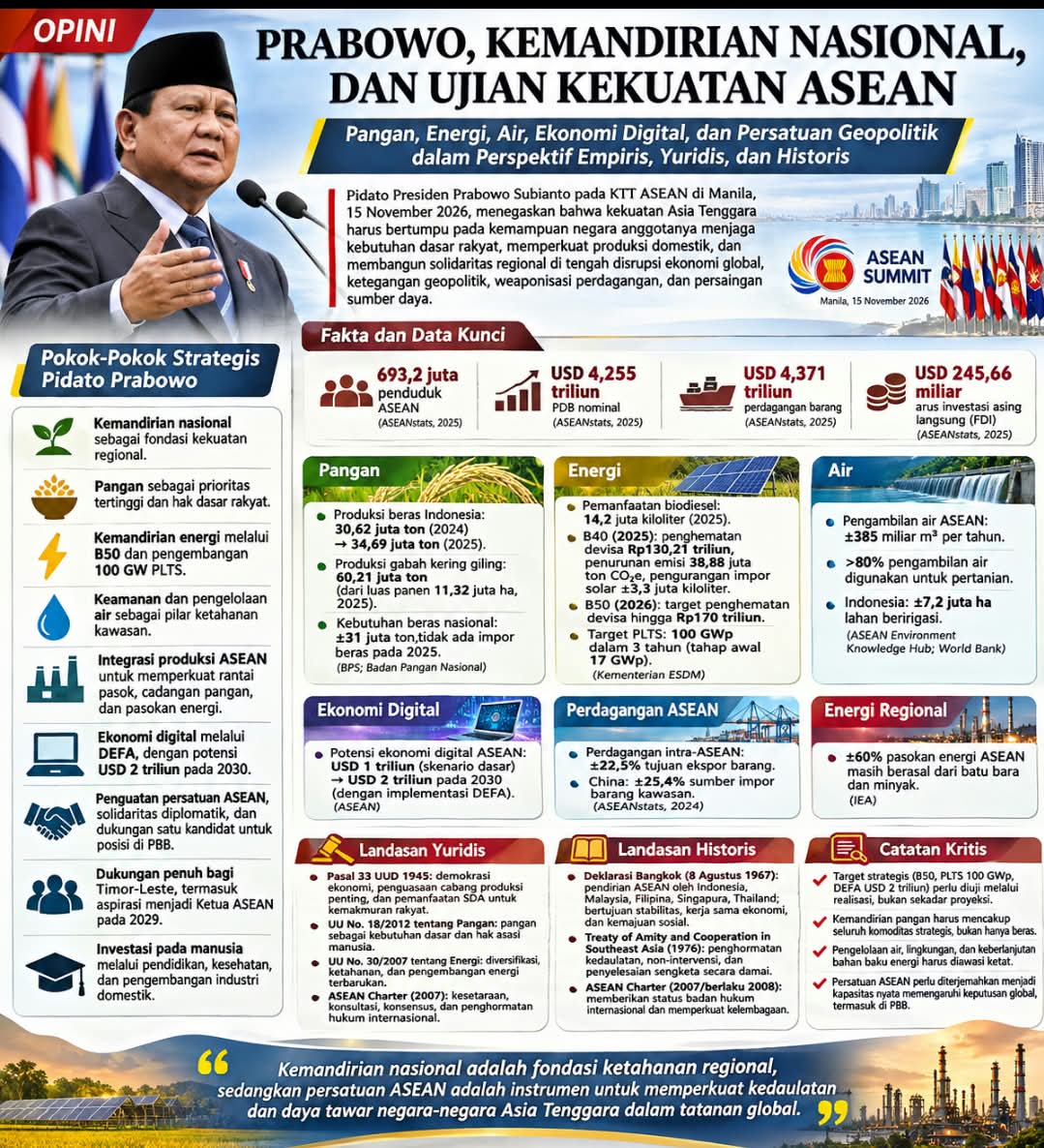
In this context, President Prabowo Subianto's speech at the APEC forum in Shenzhen is particularly relevant for analysis. Prabowo spoke about economic transformation, downstream industrial development, investment, rural development, digital technology, artificial intelligence, fair trade, and cooperation among Global South countries. He also expressed the view that the world needs friendship and cooperation rather than perpetual hostility.
Nevertheless, behind this optimism about diplomacy and economic cooperation lies a much more fundamental question: will the changing configuration of global power genuinely produce a more equitable international order, or will it merely change who controls global politics and the economy?
This question is worth examining through two works by Sheikh Taqiyuddin an-Nabhani: Mafahim Siyasiy li Hizb at-Tahrir and An-Nizham al-Iqtishadi fi al-Islam. Both provide conceptual frameworks for understanding the relationship between politics, power, ownership, resource management, and wealth distribution.
This analysis does not suggest that an-Nabhani directly addressed the 2026 Shenzhen meeting or contemporary Indonesian economic policies. Rather, it applies his intellectual framework to examine current developments in international politics and economics.
1. Multipolarity and Power
In Mafahim Siyasiy, politics is not understood merely as diplomatic activity, the struggle for political office, or formal relations between governments. Politics concerns the management of the affairs of the people, both domestically and internationally. In international relations, states do not interact solely through trade and agreements; they also bring their interests, ideas, and strategies to bear on their political conduct.
This framework requires us to distinguish between the underlying political conception, the strategy, and the instruments used to implement it. Meetings between heads of state, investment cooperation, trade agreements, and participation in international forums are political instruments. However, these instruments alone are insufficient to explain a state's fundamental orientation.
A state may change its trading partners, revise its diplomatic strategy, or expand economic cooperation. Yet, to understand its political direction, we must examine the interests and underlying conceptions that shape its policies.
From this perspective, the meeting between Xi Jinping, Trump, and Putin can be understood as part of the dynamics through which major powers manage their respective strategic interests. However, the emergence of several centers of power does not automatically guarantee the establishment of international justice.
Multipolarity describes a configuration of power: a shift from one dominant center toward several centers of influence. It does not, in itself, explain whether relations between states have become more equal.
Indeed, a multipolar world may continue to preserve structures of domination. The difference lies only in the number of actors capable of determining the international agenda. Smaller and developing countries may remain in a position where they must adjust to decisions made by these major powers.
Therefore, the meeting of the three world leaders should not automatically be interpreted as evidence of an agreement to divide spheres of influence or control other countries. Such conclusions require independent evidence. Nevertheless, the event provides sufficient grounds to examine whether changes in the international balance of power genuinely expand the sovereignty of developing countries.
This is where the relevance of an-Nabhani's political thought becomes apparent: a change in dominant actors does not necessarily mean a change in the principles and structures governing international relations.
2. Inequality in the World Order
From a legal perspective, the UN Charter recognizes the principle of the sovereign equality of states. Article 2(1) affirms that the organization is based on the principle of the sovereign equality of all its members. Article 2(3) requires the peaceful settlement of disputes, while Article 2(4) prohibits the threat or use of force contrary to the purposes of the United Nations.
However, the structure of the UN Security Council reveals institutional inequality. Of its 15 members, five hold permanent membership and possess veto power. This means that although all UN members formally enjoy sovereign status, they do not possess equal capacity to determine decisions concerning international peace and security.
This structure emerged from the political compromises made after World War II. When the United Nations was established in 1945, the victorious powers became central to the construction of the international security architecture. The compromise was intended to keep the major powers within a common institutional framework. Its consequence, however, was the granting of special institutional privileges to five states.
Through a critical reading of Mafahim Siyasiy, the issue is not merely whether the UN remains relevant, but whether its decision-making structure is capable of guaranteeing equal treatment for all states.
This issue becomes increasingly important when international law encounters the interests of major powers. Legal enforcement against one state may proceed intensively, while actions by another state receive a different response. Such differences must be examined through facts, legal procedures, and the authority of the relevant institutions, rather than simply assumed to constitute double standards.
The cases of Ukraine, Palestine, Sudan, and various other conflicts demonstrate that the protection of civilians, humanitarian access, accountability for perpetrators, and consistency in the application of international law remain major challenges.
Legal principles cannot remain mere declarations. They must be applied consistently, including to states possessing substantial military, economic, and diplomatic power.
3. The History of the Struggle for Influence
To understand these dynamics, the history of international relations provides important context.
The Peace of Westphalia in 1648 is often regarded as a milestone in the development of the modern concept of state sovereignty. Although it was not the sole origin of the concept of sovereign states, Westphalia has become an important symbol of the development of the principle of state authority over its territory.
In 1814–1815, the Congress of Vienna sought to restore the European balance of power following the Napoleonic Wars. The balance-of-power principle became one of the main instruments for preventing one state from dominating others. However, a balance of power is not synonymous with universal justice. It is primarily a mechanism for managing relations among states possessing substantial power.
Following World War II, the Yalta Conference in 1945 and the establishment of the United Nations demonstrated how the international architecture was designed through compromises among the victorious powers. Subsequently, the Cold War of 1947–1991 revealed the rivalry between two principal blocs, the United States and the Soviet Union, which shaped politics, economics, security, and conflicts across various regions.
Amid this rivalry, Asian and African countries sought to establish a position that was not entirely subordinate to the interests of major powers. The 1955 Asian-African Conference in Bandung, attended by 29 countries, produced the Ten Principles of Bandung. These principles included respect for sovereignty, territorial integrity, the equality of nations, non-interference, the peaceful settlement of disputes, and respect for human rights.
The Non-Aligned Movement was formally established in Belgrade in 1961. ASEAN was founded in 1967, while the 1976 Treaty of Amity and Cooperation strengthened the principles of peaceful dispute settlement and respect for the sovereignty of Southeast Asian states.
This historical sequence demonstrates that developing countries' efforts to expand their political space are not new. The Global South has deep historical roots in the struggle against colonialism and the domination of major powers.
However, shared historical experiences do not automatically produce collective power. Global South countries have diverse economic interests, political orientations, industrial capacities, and relationships with major powers.
APEC data for 2024 show that its 21 member economies accounted for approximately 61 percent of global GDP, 46 percent of global trade, and 37 percent of the world's population. Meanwhile, UNCTAD reports indicate that Global South countries have assumed a significant role in global production, trade, and investment flows. One of the indicators cited is that approximately 58 percent of global foreign direct investment flows in 2023 went to developing economies.
These figures demonstrate that developing countries are no longer peripheral actors in the global economy. Nevertheless, a large population, substantial production, and significant investment flows do not automatically translate into equal political influence. Economic strength must be converted into industrial capacity, technological capability, financing power, and diplomatic coordination.
4. Indonesia Between Major Powers
Prabowo's speech at APEC Shenzhen reflects Indonesia's efforts to expand cooperation with various global powers. Indonesia's agenda encompasses not only relations with China but also open trade, Global South cooperation, investment, and technological development.
In Indonesia's foreign policy history, the principle of bebas aktif—independent and active foreign policy—has its roots in Mohammad Hatta's 1948 idea known as “Rowing Between Two Reefs.” This principle subsequently became a cornerstone of Indonesian foreign policy and was incorporated into Law No. 37 of 1999 on Foreign Relations.
Article 3 of the law stipulates that Indonesia's foreign policy is implemented according to the principle of bebas aktif and is dedicated to the national interest. Article 4 further explains that foreign policy is conducted through creative, active, and anticipatory diplomacy oriented toward national interests.
However, when examined through Mafahim Siyasiy, political independence cannot be measured solely by the absence of formal alignment with a particular global power. It is also related to a state's actual ability to determine and implement its own political decisions.
This is where Indonesia faces a challenge. Its economic relations with China, the United States, Japan, Singapore, and other countries have different dimensions. Such cooperation can provide benefits for national development, but it must also be assessed in terms of its impact on Indonesia's economic capacity and policy autonomy.
Indonesia's 2025 trade data show exports of approximately US$282.91 billion, imports of approximately US$241.86 billion, and a trade surplus of approximately US$41.05 billion. China accounted for around 36.22 percent of Indonesia's imports. Meanwhile, imports of raw and auxiliary materials accounted for approximately 70.11 percent of total imports, while capital goods accounted for around 20.60 percent.
These figures do not automatically prove that Indonesia is politically dependent on China. Trade relations are a normal feature of the international economy. Nevertheless, the data provide strong grounds for examining the structure of Indonesia's industrial economy.
If most raw materials, components, machinery, and strategic technologies remain dependent on imports, a trade surplus alone is insufficient to conclude that the national economy has achieved independence.
The fundamental question is whether Indonesia possesses the capacity to develop its own industries, master technology, build supply chains, and determine the direction of strategic sectors without excessive external dependence.
Within an-Nabhani's framework, economic diplomacy should not be measured solely by the volume of investment commitments secured. It must also be assessed according to whether such cooperation strengthens the state's capacity to manage its own interests.
5. Downstream Industrial Development and Ownership
The issue of downstream industrial development represents the most significant point of convergence between Prabowo's speech and An-Nizham al-Iqtishadi fi al-Islam.
In this book, an-Nabhani constructs the economic system around three principal pillars: the concept of ownership (al-milkiyah), the rules governing the utilization of ownership (tasharruf fi al-milkiyah), and the distribution of wealth among society (tauzi' al-tsarwah baina an-nas).
He distinguishes between individual ownership, public ownership, and state ownership. These classifications have implications for who is entitled to own, manage, utilize, and benefit from sources of wealth.
Within this framework, resources classified as public property cannot simply be treated as individual property that may be freely controlled by particular parties. The state has a responsibility to manage such resources for the benefit of society.
This perspective is relevant as Indonesia develops downstream industries in minerals, energy, and other natural resources.
USGS data indicate that Indonesia possesses approximately 55 million metric tons of nickel reserves, equivalent to around 42.3 percent of global reserves. Indonesia's nickel production in 2024 reached approximately 2.2 million metric tons, representing around 59.5 percent of global production.
This position gives Indonesia significant bargaining power in the battery, electric vehicle, and strategic mineral supply chains.
In 2025, Indonesia's investment realization reached IDR 1,931.2 trillion. Investment in downstream industrial development amounted to IDR 584.1 trillion, or approximately 30.2 percent of total realized investment. The government also reported that total employment generated by investment realization reached approximately 2.71 million people.
These figures demonstrate the scale of economic activity and industrial development. However, from the perspective of An-Nizham al-Iqtishadi, the assessment of downstream industrial development cannot stop at investment value, production volume, or export growth.
Five issues must be examined simultaneously.
First, who owns and controls natural resources? Second, who controls the processing facilities? Third, who controls the technology, machinery, and production knowledge? Fourth, who determines supply chains and market access? Fifth, who receives the profits generated throughout the entire production process?
The establishment of a factory in Indonesia does not automatically mean that the entire production process is controlled by Indonesia. The location of production, corporate ownership, technological control, supply-chain control, and profit distribution are five distinct dimensions.
Therefore, the success of downstream industrial development should not be measured solely by the transformation of raw material exports into processed products, but also by the extent to which national capabilities in technology, research, manufacturing, and value creation are strengthened.
This is where an-Nabhani's criticism of the capitalist economic system becomes analytically relevant. Economic problems cannot be resolved merely by expanding production and capital. The structure of ownership and wealth distribution also determines who actually benefits from development.
6. Economic Growth and Social Justice
Indonesia recorded economic growth of approximately 5.11 percent in 2025, with nominal GDP reaching around IDR 23,821.1 trillion. However, as of September 2025, the poverty rate remained at 8.25 percent, equivalent to approximately 23.36 million people. The Gini ratio stood at 0.363.
These figures do not, by themselves, prove the failure of any particular economic policy. Nevertheless, they demonstrate that economic growth and the equitable distribution of prosperity are two issues that must be examined together.
In An-Nizham al-Iqtishadi, wealth distribution is not merely an additional program implemented after economic growth has been achieved. Distribution is one of the fundamental elements of the economic system itself.
Consequently, the success of development cannot be measured solely through GDP growth, investment, trade surpluses, or export values. It is also necessary to examine whether people have adequate access to basic necessities, employment, education, healthcare, and sources of livelihood.
Economic growth can occur alongside inequality. Investment may increase, but its benefits are not necessarily distributed evenly. Exports may expand, but the greatest added value may not be enjoyed by society and domestic industrial actors.
Therefore, the questions of who owns resources and who benefits from their proceeds are essential in evaluating the direction of development.
7. Capitalism and Dependency
An-Nabhani develops his critique of the capitalist economic system through discussions of ownership, the management of wealth, usury (riba), companies, foreign trade, and wealth distribution.
In the context of the global economy, this critique can be used to examine how capital moves across national borders, how investment controls strategic sectors, and how financing systems influence a country's economic policy.
However, the issue is not as simple as rejecting all foreign investment or international trade. Within an-Nabhani's framework, economic activities must be assessed by examining the object of ownership, the contractual arrangements, the methods of management, and the applicable Sharia provisions.
Similarly, foreign debt must be analyzed in detail. Not all debt has the same structure. Its currency, interest rate, maturity, conditions, exchange-rate risks, and intended use must be examined.
The Islamic economic critique of riba must not be confused with the empirical conclusion that every form of debt produces identical consequences. An analysis must distinguish normative principles from the characteristics of financial contracts and their actual economic effects.
The same applies to international trade. Trade can benefit a country, but it can also reinforce dependency if its industrial structure fails to develop.
A country may become a major commodity exporter while remaining a market for high-value industrial and technological products from other countries. Therefore, a trade surplus is not necessarily synonymous with economic independence.
8. Technology and Sovereignty
One of the important elements of Prabowo's speech was his emphasis on artificial intelligence and technological innovation. According to the idea expressed in his speech, developing countries must not remain merely consumers of technology.
This issue has both geopolitical and economic dimensions.
Technology is not merely a production tool; it is also a source of political power. Countries that control strategic technologies have greater capacity to determine industrial standards, control supply chains, manage data, and establish economic advantages.
Indonesia's research and development expenditure in 2023 remained at approximately 0.28 percent of GDP. This figure illustrates the challenges facing the country in building its national research and innovation capacity.
In the digital economy, the issue is not merely the number of internet users or the size of digital transactions. Control over data centers, computing infrastructure, software, semiconductors, AI technology, intellectual property, and skilled professionals also determines who captures the added value.
If Indonesia provides only the market, data, labor, and natural resources, while core technologies and strategic profits are controlled by external parties, digital transformation may fail to generate economic independence.
From the perspective of Mafahim Siyasiy, technological control is closely related to a state's ability to determine its policies and safeguard its strategic interests. Meanwhile, An-Nizham al-Iqtishadi directs attention toward the control of the means of production, ownership, and the distribution of economic benefits.
Both perspectives converge on one fundamental issue: technology must strengthen the capacity of society and the state rather than merely create new forms of dependency.
9. The Global South and the Muslim World
Prabowo's proposal for cooperation among Global South countries has historical roots in the struggle of developing nations to secure greater political and economic space on more equal terms.
However, sharing the status of developing countries does not automatically produce common interests. Global South countries have different political orientations, resources, industrial capacities, and relationships with major powers.
To become an influential force, Global South cooperation requires a strategic agenda, economic capacity, technological mastery, political coordination mechanisms, and the ability to sustain collective decisions.
The same applies to the Muslim world. Shared religious identity does not automatically produce unified political and economic policies. Muslim-majority countries have diverse national interests, economic structures, and international orientations.
In a reading of an-Nabhani's thought, the challenges facing the Muslim community cannot be resolved through symbolic solidarity alone. Institutional and material capabilities are required to pursue common interests.
At least three sectors deserve particular attention.
First, energy and natural resources. Abundant resource ownership does not automatically produce independence if processing technology, financing, distribution, and strategic markets remain heavily dependent on external parties.
Second, industry and technology. Independence requires research capabilities, manufacturing capacity, technological mastery, and the development of supply chains.
Third, diplomacy and international positioning. Solidarity must be translated into policy coordination, humanitarian assistance, economic cooperation, and mechanisms for resolving conflicts.
In the context of Palestine, Ukraine, Sudan, and other conflicts, consistency in protecting civilians and ensuring humanitarian access remains a crucial test. The Muslim world and the Global South can expand their diplomatic roles through measurable cooperation while recognizing the diversity of interests among their member states.
10. Law and Power
International law was also an important issue in the Shenzhen meeting. The declaration addressed questions of jurisdiction and immunity for state officials, as well as the role of the International Criminal Court (ICC).
Several legal issues must be distinguished here.
The Rome Statute establishes the ICC's jurisdiction over four principal categories of crimes: genocide, crimes against humanity, war crimes, and the crime of aggression. Article 27 provides that official capacity does not, in principle, exempt an individual from criminal responsibility before the Court. Article 98, meanwhile, addresses cooperation issues involving a state's obligations concerning immunities or the consent of a third state.
The ICC arrest warrant issued against Vladimir Putin on March 17, 2023, concerns allegations of the unlawful deportation and transfer of Ukrainian children. The warrant is not a conviction; rather, it is a judicial measure issued on the basis of an assessment that sufficient grounds existed for its issuance.
In October 2024, the ICC determined that Mongolia had failed to comply with its cooperation obligations in relation to the execution of the warrant and referred the matter to the Assembly of States Parties.
This issue illustrates the complexity of the relationship between immunity for state officials, international jurisdiction, and the obligation of states to cooperate. The International Court of Justice's judgment in the 2000 Arrest Warrant case also demonstrates the importance of distinguishing jurisdiction, immunity, and individual responsibility. Immunity in a particular context should not simply be equated with the elimination of accountability.
Meanwhile, regarding Palestine, the International Court of Justice's advisory opinion of July 19, 2024, concluded that Israel's continued presence in the occupied Palestinian territory is unlawful under international law. In the case brought by South Africa against Israel, the provisional measures ordered by the Court did not constitute a final judgment that genocide had been proven.
These distinctions are important to ensure that allegations, provisional measures, advisory opinions, arrest warrants, and final judgments are not conflated.
From a political perspective, the debate over reforming international institutions must be examined through one fundamental question: is such reform intended to expand justice and accountability, or does it risk providing greater protection for powerful states?
This question also applies to nuclear and energy governance. The 1968 Treaty on the Non-Proliferation of Nuclear Weapons, the 1996 Comprehensive Nuclear-Test-Ban Treaty, and the 2017 Treaty on the Prohibition of Nuclear Weapons demonstrate that the international community has established various legal instruments to regulate nuclear threats. However, differences in membership status, obligations, and state compliance show that international law continues to face challenges in implementation.
Therefore, peace cannot be measured solely by agreements reached among world leaders. It must also be assessed through the protection of civilians, the cessation of violence, humanitarian access, and accountability for violations of the law.
11. Indonesia's Sovereignty Agenda
For Indonesia, all these developments have direct implications for the direction of national policy.
The Preamble to the 1945 Constitution establishes the state's objectives within the framework of protecting the entire nation, advancing public welfare, educating the nation, and contributing to the establishment of a world order based on freedom, lasting peace, and social justice.
Article 11 of the 1945 Constitution regulates the President's authority to declare war, make peace, and conclude agreements with other countries, subject to parliamentary approval in accordance with constitutional provisions. Law No. 24 of 2000 further regulates international agreements.
These constitutional foundations demonstrate that Indonesian diplomacy is not merely an executive activity; it is also part of the country's constitutional order.
However, political sovereignty requires economic foundations. A state that is formally free to determine its policies may still face limitations if its industrial, technological, energy, food, and financing capacities are excessively dependent on external parties.
Therefore, six agendas deserve serious attention.
First, strengthening the consistency of Indonesia's independent and active foreign policy through diplomacy oriented toward national interests, respect for international law, and the ability to take initiatives in resolving global issues.
Second, strengthening industrial independence through mastery of technology, research, manufacturing, and strategic supply chains, rather than merely increasing the number of investment projects.
Third, evaluating natural resource management based on ownership structures, control, and the distribution of proceeds, while taking into account the characteristics of each type of resource and the applicable legal framework.
Fourth, developing a financing system that strengthens national productive capacity while managing debt risks, exchange-rate exposure, and financial dependency.
Fifth, ensuring that economic growth is accompanied by improvements in wealth distribution, employment opportunities, and public access to basic necessities.
Sixth, expanding cooperation with developing countries and the Muslim world through concrete programs in energy, food, industry, technology, education, and humanitarian diplomacy.
These agendas cannot be separated from the reality that Indonesia possesses significant natural resources, a large population, a strategic maritime position, and a substantial domestic market. However, these potential advantages can become genuine sources of power only when supported by productive capacity, technology, institutions, and consistent policies.
12. Defining the Direction of the Future
Ultimately, examining Prabowo's speech at APEC Shenzhen and the meeting between Xi Jinping, Donald Trump, and Vladimir Putin brings us back to a fundamental question concerning the direction of the world order.
From the perspective of Mafahim Siyasiy, changes in the configuration of international power must be assessed according to the interests, political ideas, and capacity of states to determine the direction of their relations with other countries.
Meanwhile, An-Nizham al-Iqtishadi fi al-Islam reminds us that economic issues do not end with production and growth. The structure of ownership, the management of wealth, and the distribution of resources are inseparable components of an economic system.
Together, these works offer two dimensions for understanding sovereignty. The political dimension concerns who determines decisions. The economic dimension concerns who owns and controls sources of wealth and who benefits from them.
The world may move from unipolarity to multipolarity without necessarily becoming more just. Indonesia may increase investment, expand exports, and accelerate downstream industrial development without necessarily controlling strategic technologies and value chains. Global South countries may possess substantial demographic and economic strength without necessarily being able to establish a common political agenda.
Therefore, sovereignty cannot be measured solely by a country's ability to position itself among major powers. Sovereignty also concerns the capacity to determine the direction of development, control productive capabilities, manage strategic resources, and ensure that wealth benefits society as a whole.
Within an-Nabhani's intellectual framework, all these issues are situated within a conception of political and economic systems founded upon Islamic creed and Sharia principles. This is a normative proposal fundamentally different from both capitalism and socialism. Its application therefore requires separate consideration within the context of Indonesia's constitutional framework, positive law, and social diversity.
Nevertheless, regardless of the differences in the systems from which countries derive their approaches, one question remains relevant to every nation: are political and economic powers genuinely used to serve the interests of society, or do they instead turn society into an object of power and capital?
This is the question that should lie at the heart of any examination of the changing world order. Peace without justice risks becoming merely an interval before the next conflict. Growth without distribution may increase economic figures without guaranteeing prosperity. And sovereignty without the ability to determine political direction and control economic foundations risks remaining nothing more than formal recognition.
Indonesia's future will ultimately be determined not only by its ability to build relations with major powers, but also by its capacity to develop its own strength, determine the direction of its development, and ensure that all the nation's resources are devoted to the interests of its people.[]